What Is XIRR? Complete Investor Guide to Understanding Portfolio Returns
XIRR (Extended Internal Rate of Return) is a globally accepted method for calculating the return of an investment portfolio by considering the exact dates and amounts of all transactions.
Most investors buy and sell stocks at different times and in varying amounts. A simple percentage return cannot accurately reflect such activity. XIRR solves this problem by considering:
- Investment dates
- Purchase amounts
- Sale proceeds
- Dividend income
- Current market value of holdings
The result is a single percentage that shows how efficiently your money has grown over time.
Why Is XIRR Better Than Simple Returns?
Many investors calculate returns using:
Profit ÷ Investment × 100
While easy to understand, this approach ignores timing. For Example :
Suppose you:
- Invest ₹1 lakh in January
- Invest another ₹1 lakh in November
A simple return treats both investments equally. However, the January investment remained in the market for nearly a year, while the November investment was invested for only a few weeks. XIRR recognizes this difference and provides a more accurate performance measurement.
How to Check Your XIRR in MyGeojit?
Finding your XIRR is simple.
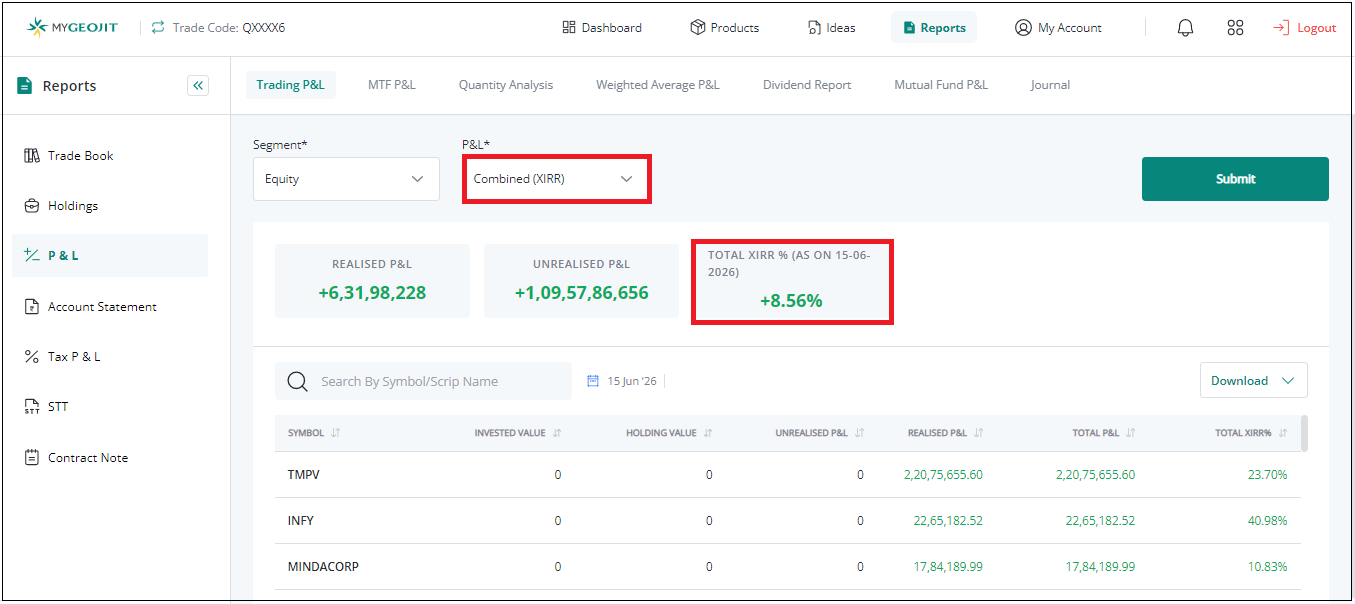
- Log in to MyGeojit.
- Go to Reports.
- Choose P&L.
Read More : Why Is XIRR Unavailable in My P&L Report?
Will XIRR include all my trading and Demat accounts under my name?
Yes. Your XIRR is computed at the Primary Holder level, using your unique Client Master ID. This means all accounts linked to your PAN / Client ID (including multiple DP accounts and joint accounts where you are the primary holder ) are combined into a single, unified portfolio XIRR.
Will a branch transfer or new trade code affect my XIRR?
No. Your old and new trade code transactions are automatically merged, ensuring a continuous and accurate XIRR calculation.
When is my XIRR updated? Why are my most recent trades not included yet?
Your XIRR is recalculated every Sunday, and the updated value is reflected on your dashboard on Monday.
How Corporate Actions Affect XIRR?
Bonus Shares
A bonus issue increases the number of shares you own without requiring additional investment.
Geojit's system automatically adjusts historical transactions using the Cumulative Adjustment Factor (CAF) methodology, ensuring that XIRR remains accurate.
Key Points
- Original investment amount remains unchanged.
- Share quantity increases.
- XIRR remains unaffected by accounting adjustments.
Stock Splits
A stock split increases the number of shares while proportionally reducing the share price.
Because no new money is invested, stock splits do not create additional cash flows within the XIRR calculation. Historical data is automatically restated for consistency.
What Does "Performance Under CA Adjustment" Mean?
You may occasionally see the message:
Performance Under CA Adjustment
This usually occurs after a bonus issue or stock split.
During the settlement period, holdings may not yet reflect newly credited shares. To prevent inaccurate calculations, the system temporarily freezes the previously verified XIRR value until updated records are received.
What does 'CA settlement overdue. Under review.' mean on my dashboard?
This means the SEBI-mandated deadline for crediting your Demat account after a corporate action has passed, but your Demat holdings have still not been updated. Your XIRR remains frozen at the last correct value during this period. You do not need to take any action. The team will resolve this and update your XIRR as soon as the situation is clarified.
Why Is a Stock Missing From My XIRR Report?
If a stock is missing, it is likely captured in your Exception Report, which lists all securities excluded from XIRR and the reason. Check your dashboard for the Exception Report section ( Reports > P&L> Quantity Analysis).
Common Reasons and Recommended Actions :
- No buy history on record - Make a manual entry via MyGeojit.
- Suspended/Delisted security - Current market price is not available. The stock will be included automatically once a valid market price becomes available.
- Off-market transfer/gift - Make a manual entry via MyGeojit.
Read More : How to add manual transactions?
What is a good XIRR for an equity portfolio in India?
XIRR expectations vary by market conditions and investment style, but the table below provides a general benchmark for Indian equity portfolios
| XIRR | Interpretation |
|---|---|
| Below 0% | Portfolio loss |
| 0%–10% | Conservative returns |
| 10%–15% | Good long-term performance |
| 15%–25% | Strong performance |
| Above 25% | Exceptional returns |
Please Note : XIRR becomes more meaningful when evaluated over periods of three years or longer. Short-term XIRR can be significantly influenced by the timing of recent large investments.
Why did my XIRR change significantly this week even though I made no new transactions?
Several factors can influence weekly XIRR even when no trades occur:
- Market price movement - The value of your holdings fluctuates with market movements. Significant changes in stock prices can impact your XIRR
- Corporate action processed: A Bonus or Split that was pending in prior weeks has now been settled and your XIRR has been recomputed with the correct adjusted quantities.
- Exception resolved: A stock that was previously excluded has now been included after data correction.
I have invested a large amount very recently. Why does my XIRR look unrealistically low or distorted?
This is a known mathematical behaviour of XIRR. When a large portion of your total invested amount was bought recently (within the last 30 days), the XIRR has very little time to 'earn returns' on that capital. This pulls the annualized rate down significantly, even if the same stocks are performing well on older investments.
For example: If you invested Rs 50,000 over 3 years and then invested Rs 2 lakh last week, the Rs 2 lakh has only earned returns for a few days — dragging the overall annualised XIRR down even if the Rs 50,000 has done very well.
Your dashboard may show a note: 'Recent large investment may affect XIRR accuracy.' This is informational only. As time passes, the XIRR will stabilize and reflect true performance.
Does Geojit show XIRR for individual stocks, or only for the whole portfolio?
Geojit provides both Portfolio XIRR and Stock-Level XIRR, giving you a complete view of your investment performance.
- Portfolio XIRR- Shows a single annualized return for your entire equity portfolio. This is the primary measure of your overall portfolio performance.
- Stock-level XIRR- Shows the annualized return for each individual stock.
- For stocks that you have completely sold, the Stock-Level XIRR reflects the realised return up to the date of your final sale.
- For stocks you still hold, the Stock-Level XIRR includes both realised gains or losses (if any) and the current market value of your remaining shares.
I sold all my shares in a particular stock years ago. Will it appear in my XIRR?
Yes — but only at the stock level, not the portfolio level. For the portfolio XIRR, only stocks with current open holdings contribute a terminal valuation cashflow. However, all your historical buy and sell transactions, including fully closed positions, are included in the portfolio's cashflow history and influence the overall XIRR.
I notice my XIRR says 'null' or is not displaying. What does this mean?
A null or missing XIRR means one of the following conditions was detected and the value could not be published safely:
- All transactions for your portfolio are sells with no corresponding buys — there is no investment baseline.
- The XIRR algorithm could not converge to a solution (very rare edge case).
- A corporate action is pending and this is the first calculation cycle — no prior XIRR exists to freeze.
- Your portfolio has only buy transactions and the current market value is unavailable.
Once the underlying data issue is fixed, the system will automatically update your XIRR.
Read More : Why Is XIRR Unavailable in My P&L Report?
Still need help? Create Ticket


